
PUSUN PT-MAX C Review: Features, Benefits & Performance
If you are looking for a powerful tennis ball machine that can help you train more effectively without always needing...
By

Choosing the right tennis ball machine can make a major difference to the quality of your solo training. Two models worth comparing are the PUSUN PT-MAX C and the Spinfire Pro 2. Both are designed for serious practice and offer adjustable speed, spin, oscillation and remote/app control, but they approach training in slightly different ways.
In this guide, we compare the PUSUN PT-MAX C vs Spinfire Pro 2 across speed, ball capacity, battery life, programming, controls, portability and training versatility. PUSUN PT-MAX C vs Spinfire Pro 2
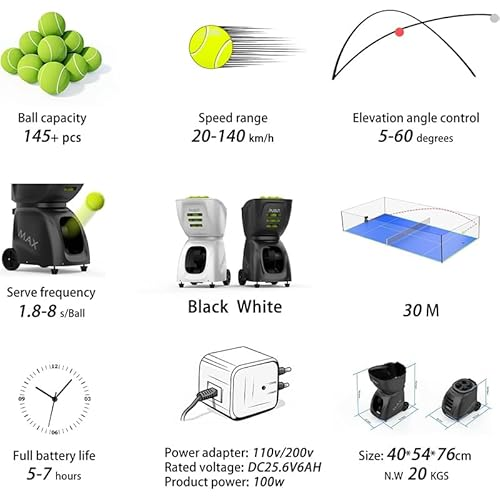
| Feature | PUSUN PT-MAX C | Spinfire Pro 2 |
|---|---|---|
| Maximum speed | Up to 140 km/h (87 mph) | Up to 130 km/h (80 mph) |
| Minimum speed | 20 km/h | 32 km/h |
| Ball capacity | 145+ balls | 150 balls |
| Feed interval | 1.8–8 seconds | 2–15 seconds |
| Oscillation | Internal | Internal |
| Spin | 6-level topspin/backspin | Topspin, slice and adjustable spin |
| Programming | Programmable court placements/drills | App AI Drill Creator + programmable drills |
| Controls | App, remote and Apple Watch | App, remote and control panel |
| Sports | Tennis and padel | Tennis and padel |
| Battery | Approximately 5–8 hours depending on configuration/source | Approximately 3–8 hours depending on battery |
| Weight | Around 20 kg | Approximately 18–24 kg depending on battery |
Specifications can vary by configuration and market, so buyers should confirm the exact version supplied by the seller.
The PUSUN PT-MAX C is positioned as a high-performance tennis and padel ball machine with a strong focus on programmable training.
It can deliver balls at speeds from 20 to 140 km/h, giving players a wide range for everything from controlled repetition to faster reaction and rally practice. PUSUN also specifies adjustable feed intervals of approximately 1.8 to 8 seconds per ball.
One of its key features is programmable ball placement. Depending on the current PT-MAX C version, PUSUN lists 35-point placement on its product page, while another current product specification lists 28 programmable landing points. This makes it important to check the exact specification of the version being purchased. PUSUN PT-MAX C vs Spinfire Pro 2
The PT-MAX C also supports internal oscillation, meaning the machine can change the direction of the ball without having to rotate the entire unit.
These features make the PT-MAX C particularly interesting for players who want to create varied solo-training sessions rather than simply repeat the same ball feed.
The Spinfire Pro 2 is a well-established ball machine designed for players who want a combination of portability, versatility and straightforward controls.
Its maximum ball speed is 80 mph / 130 km/h, while the machine can operate down to approximately 20 mph / 32 km/h. It has a 150-ball capacity, internal horizontal movement, vertical randomisation and two-line drills.
The Spinfire Pro 2 also includes automatic variation of speed, spin and interval, along with extreme topspin, slice and lob capabilities. The current product information additionally lists the Spinfire App with AI Drill Creator, allowing players to create and manage training drills through the app. PUSUN PT-MAX C vs Spinfire Pro 2
The manufacturer also lists large transport wheels and a retractable handle, helping with movement between the car, storage area and tennis court. PUSUN PT-MAX C vs Spinfire Pro 2
Speed is one of the clearest differences between these two machines.
The PT-MAX C reaches 140 km/h (87 mph), while the Spinfire Pro 2 reaches 130 km/h (80 mph).
That additional speed range on the PT-MAX C can be useful for players who want to work on faster reaction drills and higher-paced ball striking.
However, maximum speed is only one part of a ball machine’s performance. Feed frequency, spin, placement, trajectory and randomisation can all affect how challenging a training session feels.
Both machines are designed to reduce interruptions during training.
The PT-MAX C is listed with a capacity of 145+ balls, while the Spinfire Pro 2 holds 150 balls.
The difference is small enough that, for most players, capacity is unlikely to be the deciding factor.
A full hopper can provide a substantial number of repetitions, allowing players to concentrate on technique, footwork and consistency instead of continually collecting and reloading balls.
Battery life is another important consideration for players who regularly train away from a power outlet.
PUSUN lists approximately 5–8 hours for current PT-MAX C configurations, while other PUSUN specifications list around 5–7 hours depending on the battery configuration. PUSUN PT-MAX C vs Spinfire Pro 2
Spinfire lists approximately 3–8 hours, depending on battery configuration.
Actual runtime will depend on factors such as feed frequency, speed, spin settings and battery condition.
Modern tennis ball machines are increasingly controlled from smartphones rather than relying entirely on physical controls.
The PT-MAX C supports control through the PUSUN app, remote and supported Apple Watch functionality. PUSUN says the app can be used without an internet connection, while the remote provides controls for starting, stopping, direction, speed, interval and spin.
The Spinfire Pro 2 offers its own app, remote control and control panel. Its current product page also highlights the Spinfire App with AI Drill Creator.
For players who like creating structured training sessions, app-based controls can make it easier to change drills without walking back to the machine.
Both machines can be used for tennis and padel training, making them more versatile than tennis-only ball machines.
The PT-MAX C is specifically marketed for both sports and provides adjustable speed, spin, height and placement.
Spinfire also lists the Pro 2 as suitable for both tennis and padel.
For players who participate in both sports, this dual-purpose capability can make a ball machine a more flexible training investment. PUSUN PT-MAX C vs Spinfire Pro 2
A good ball machine should do more than simply shoot balls at one location.
The PT-MAX C supports fixed-point feeds, horizontal and vertical movement, deep and short balls, two-line and three-line patterns, cross-court feeds, random balls, lobs, topspin and backspin.
The Spinfire Pro 2 offers horizontal randomisation, vertical randomisation, two-line drills, automatic variation, topspin, slice and lob training.
This allows both machines to be used for different types of practice, including:
Although both machines are portable, they are substantial pieces of equipment.
The PT-MAX C is listed at approximately 20 kg, while the Spinfire Pro 2 ranges from roughly 18–24 kg, depending on battery configuration. Both include wheels and transport features designed to make moving the machine easier.
For players who frequently transport their machine, it is worth considering not only weight but also:
Rather than looking only at maximum speed, consider what type of training you want to perform.
For higher maximum ball speed:
The PT-MAX C reaches up to 140 km/h, compared with 130 km/h for the Spinfire Pro 2.
For a large hopper:
Both offer approximately 145–150 balls, so the difference is relatively small.
For programmable training:
Both machines provide advanced drill options and app-based control, although their programming systems differ.
For multiple control options:
The PT-MAX C offers app, remote and supported Apple Watch control, while the Spinfire Pro 2 offers app, remote and onboard controls.
For tennis and padel:
Both models support training for the two sports.
The PUSUN PT-MAX C and Spinfire Pro 2 are both capable options for players looking to improve their game through solo practice.
The PT-MAX C combines up to 140 km/h speed, programmable placement, internal oscillation, app control, multiple control options and long battery operation. PUSUN PT-MAX C vs Spinfire Pro 2
The Spinfire Pro 2 combines up to 130 km/h speed, 150-ball capacity, internal movement, randomisation, multiple drill patterns, app control and automatic variation.
The best choice depends on the player’s preferred training style, required speed, drill requirements, battery configuration, budget and whether tennis, padel or both are part of their training routine. PUSUN PT-MAX C vs Spinfire Pro 2
For buyers in South Africa, it is also worth checking shipping costs, warranty coverage, battery configuration, replacement parts and after-sales support before purchasing a tennis ball machine.